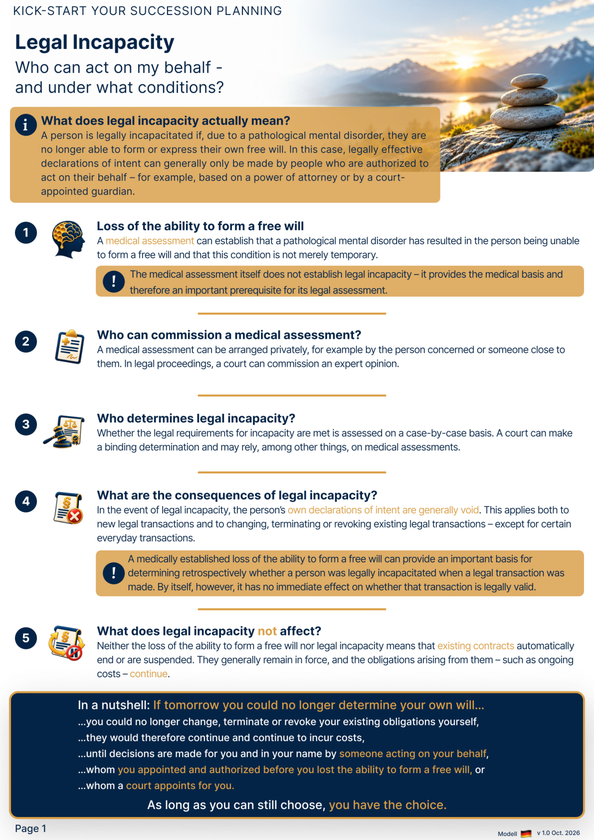
What is this about?
A person is legally incapacitated if, due to a pathological mental disorder, they are no longer able to form or express their own free will. In that case, legally effective declarations of intent can generally only be made by people who are authorized to act on their behalf – for example under a power of attorney or by a court-appointed guardian. This overview summarises what that means and who may act under which conditions.
Why did we create the overview?
Many people underestimate how quickly existing obligations continue if they can no longer determine their own will – and how decisive it then becomes whether a suitable power of attorney is in place. Without clear arrangements, uncertainty, delay and, in doubt, court-appointed guardianship can follow.
The overview is meant to help you understand legal incapacity before an emergency arises: what it means, who determines it, what the consequences are and which four ways to be represented exist. That makes it easier to shape your own preventive arrangements early and deliberately.
What does the overview contain?
- What legal incapacity means and the loss of the ability to form a free will
- Who can commission a medical assessment and who determines legal incapacity
- Consequences for new and existing legal transactions and ongoing obligations
- Four ways to be represented: unconditional power of attorney, restrictions on use, conditions and no sufficient power of attorney
- A closer look at the Federal Ministry of Justice sample preventive power of attorney (internal and external relationship)
Who is the overview for?
- For people who want to clarify their power of attorney and representation rules in good time
- For relatives and authorized persons who want to better understand the internal and external relationship of a power of attorney
- For anyone who wants to know what happens if no sufficient power of attorney is in place
- For anyone who wants a compact overview before going deeper into their own preventive planning