

No clear
trigger
- There is no defined moment to act.
- No deadline. No external pressure.
- Without a trigger, action is continuously postponed.

Digitization continuously increases the number of possible estate items. New online services, customer accounts,
shopping platforms, memberships, and digital access points automatically become part of the estate.
However, the number of items alone says nothing about their significance to the estate or the complexity of later
administration. On the contrary: an unused customer account or a forgotten user profile often has no impact at all.
Classic assets and obligations are often different. Property, insurance, bank accounts, or loans are usually
significantly more complex. Understanding and settling them requires considerably more time and information. At the
same time, mistakes or oversights here can have a substantial impact on the estate.
Effective estate complexity therefore depends not solely on the number of estate items, but above all on their
significance, administrative effort, and potential impact on the estate.
It may sound surprising, but until now there has been no robust answer to how many components an estate actually contains.
With this analysis we developed, for the first time, an integrated view of the real structure of an estate and systematically quantified the complexity of personal wealth structures.
For classic assets and liabilities, solid statistical foundations exist. The digital world is so fragmented that simple aggregation is not enough. We therefore chose a different approach and used the one property all components share: access via credentials.
International studies on password use provide a robust order of magnitude for the total number of digital access points. That is our baseline. Within that total we identified, categorised, and individually assessed the structurally relevant components.
For each type we captured two dimensions:
A central finding is that a single asset is usually not represented by a single access point.
Instead, multiple access details and dependencies are required to obtain access.
That is how more than 100 individual values quickly become more than 250 necessary parts that must be brought together to form a complete picture of the estate.
Most people don’t structure their estate in time — not because of an informed, deliberate decision, but because of a combination of barriers operating on two distinct levels:



Stopping here shifts a lifetime of decisions onto heirs — with less information, more pressure, and far less time to get it right, while they are also dealing with loss and everything that comes with it.
While ownership used to be the primary factor, access is equally critical today. Unlike ownership, access is inherently dynamic: what is reachable today may not be reachable tomorrow.
This shift changes the problem itself: barriers that once stood apart merge and reinforce each other — and become a structural challenge that effort or persistence alone can no longer solve.
The greatest advantage of digitization is that information can be easily copied, linked, and shared in a targeted way. This makes it possible not only to define which information is available, but also who may access it and when.
What is often costly or barely feasible on paper becomes significantly easier in digital form.
At the same time, digitization helps in dealing with complex information. Data can be structured, consolidated, and prepared in a way that is easy to understand. Reality does not become simpler as a result – but it becomes much easier to overview and manage.
Loss of control.
Responsibility transfers immediately…
… transparency does not.
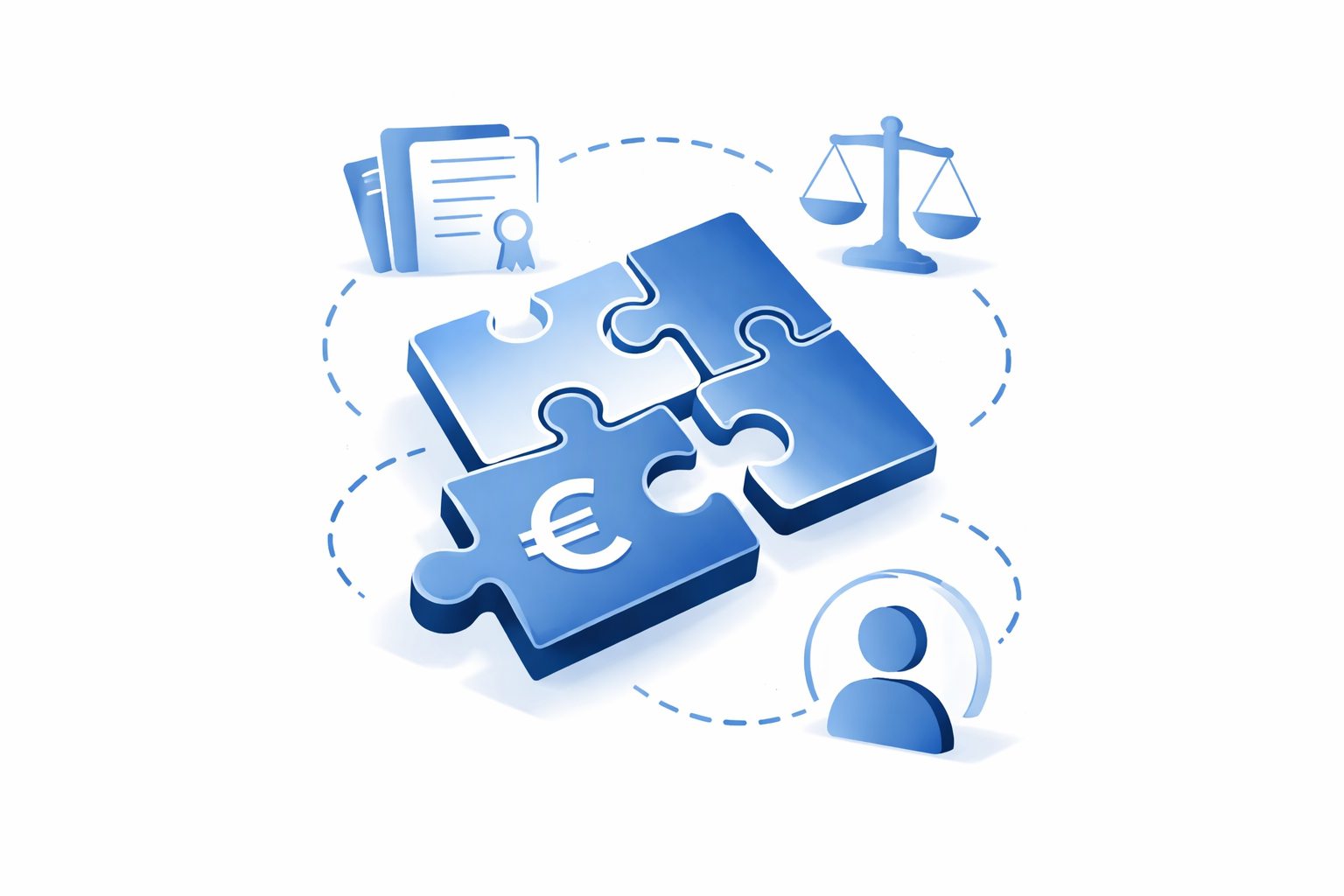
Those who actively manage their data leave successors not isolated puzzle pieces, but a complete, intelligible overall picture — sparing them a great many problems.
Estate planning is not a static topic.
Legal frameworks, typical mistakes, and structural relationships keep evolving — and taken together, they are hard to keep in full view.
We summarize relevant developments, show how they connect, and add concrete guidance.